

Which workplace policy best supports menstrual health: menstrual leave or flexible scheduling? Research shows flexible scheduling provides the most practical day-to-day support for changing symptoms, while menstrual leave offers an essential safety net when working isn’t possible.
Combining both approaches helps organisations support people’s natural rhythms while maintaining steady productivity.
Why Do Workplaces Need Menstrual Health Support?
How Painful Periods and Menstrual Conditions Affect Work
Menstrual experiences differ from person to person, and symptoms can shift from one cycle to the next. Around 80 percent of women and people who menstruate experience period pain, known as dysmenorrhea, at some stage during their working lives. For five to ten percent, the pain is severe enough to disrupt daily life.
In the workplace, the greatest impact on productivity comes from presenteeism rather than absence. Presenteeism happens when someone turns up to work while unwell and cannot perform at their best.
A Dutch study of more than 32,000 women published in BMJ Open showed that menstrual symptoms led to an average of 1.3 days of sick leave each year, compared to 8.9 days of lost productivity through presenteeism.
When workers must sit through severe pain or manage heavy bleeding in rigid environments, focus drops, mistakes increase, and recovery takes longer.
How Stigma Prevents Employees From Requesting Support
Menstruation is a healthy biological rhythm experienced by roughly half the global population for around 3,000 days of their lives. Despite this, it’s still treated with silence and discomfort. Cultural taboos have long framed reproductive health as an inappropriate topic for professional settings. As a result, employees often hide cramps, heavy bleeding, low energy, and emotional shifts from their teams.
This silence stops people from asking for adjustments when they need them. Workplace surveys reveal that fewer than one in four workers feel comfortable naming menstrual pain as the reason for an absence or delay. Many worry their symptoms will be dismissed or that they’ll be viewed as less capable. Instead of asking for a change of hours or stepping away during a difficult flare, many people push through with painkillers and hide their discomfort.
These challenges can be even greater for marginalised groups. Trans men and non-binary people who menstruate may fear being outed or mistreated if they bring up menstrual health needs. Without open, respectful communication, workers are left to navigate significant physical needs without support.
Why Standard Sick Leave May Not Meet Every Employee’s Needs
Employers often assume that general sick leave covers all health issues. However, standard personal leave isn’t designed for recurring, cyclical conditions. It’s built for unexpected, short-term illnesses like a cold, a stomach bug, or an injury-not ongoing symptoms that return every few weeks.
Someone managing severe primary dysmenorrhea or endometriosis might need time off every month, quickly running through their allocated paid leave. Within a few months, they may have no paid leave left for other illnesses, operations, or family care. This places a disproportionate financial burden on menstruating employees and can widen the gender pay gap when workers are forced onto unpaid leave.
Standard leave policies also bring administrative hurdles. Many employers ask for a doctor’s certificate for every absence. Expecting someone with intense cramps to travel to a clinic, sit in a waiting room, and pay for a note to prove a recurring symptom creates unnecessary stress.
For most people, these episodes call for rest, warmth, and time rather than acute medical care.
What Is the Difference Between Menstrual Leave and Flexible Scheduling?
What Does Menstrual Leave Provide?
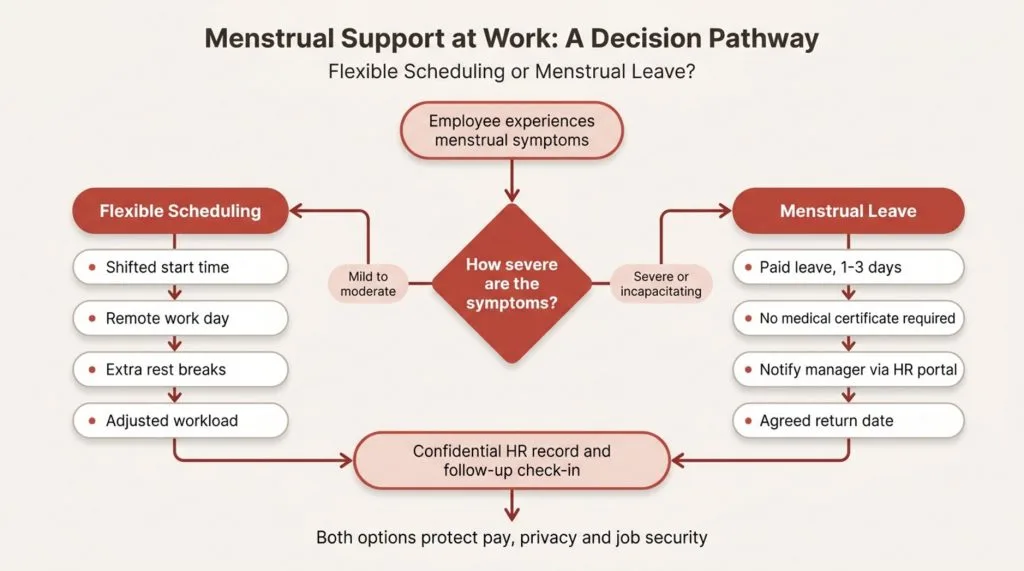
Menstrual leave gives employees a formal right to take time away from work when symptoms make working impossible. Depending on workplace policies or regional laws, this leave can be paid, partly paid, or unpaid, ranging from one to three days per cycle or a set number of days each year.
At its heart, menstrual leave protects income and wellbeing. It recognises severe menstrual pain as a legitimate health reason to rest. A separate leave balance stops general sick leave from running out and saves workers from having to disguise their symptoms under other illnesses.
What Does Flexible Scheduling Provide?
Flexible scheduling changes when, where, and how tasks are done, allowing employees to remain engaged with their work. Adjustments might include altered start and finish times, remote or hybrid arrangements, split shifts, planned rest breaks, or reordered tasks.
Flexibility centres on personal autonomy. An employee dealing with heavy bleeding, lower-back ache, or pelvic tenderness might find an hour-long commute or eight hours at an office desk unbearable, yet they can still complete focused tasks at home. Adapting the work pattern helps sustain output while honouring the body’s changing needs.
How Do Both Options Support Menstrual Health at Work?
While menstrual leave and flexible scheduling work differently, both move away from the assumption that every employee has identical physical capacity every day of the month. Both acknowledge that cyclical shifts can affect how people perform.
These policies integrate reproductive health into standard workplace wellbeing. Menstrual leave provides essential time off when symptoms are incapacitating, while flexible scheduling supports individuals with moderate discomfort who want to stay productive on their own terms.
The Benefits and Risks of Menstrual Leave
How Menstrual Leave Can Improve Wellbeing and Retention
A well-managed menstrual leave policy supports employee health by reducing the pressure to push through severe pain. When workers can rest without sacrificing pay or using up annual holidays, they experience lower stress, less burnout, and a healthier relationship with their cycle.
For businesses, offering paid leave can attract and retain skilled talent. Progressive health policies signal that an organisation genuinely values its people. This builds loyalty, reduces staff turnover, and helps workplaces hold onto experienced team members.
Why Employees May Avoid Using Menstrual Leave
A policy on paper doesn’t guarantee people will use it. Many employees hesitate to take menstrual leave because they worry about being perceived as unreliable, fragile, or uncommitted to their responsibilities.
These concerns are often heightened in male-dominated industries like engineering, mining, finance, and tech, where asking for leave can feel like feeding into existing biases. Staff may also feel guilty about leaving colleagues to cover extra work. Without supportive coverage systems, many workers choose to endure severe pain at work rather than cause friction within their team.
Could Menstrual Leave Reinforce Gender Stereotypes?
A frequent critique of standalone menstrual leave is that it can unintentionally revive outdated ideas about women’s capability. In the 1920s, the Soviet Union introduced menstrual leave for female factory workers, only to repeal it five years later after it framed women as less suited to industrial work.
Some researchers and employees worry that dedicated policies treat menstruation as a medical problem or personal weakness. In one study of young working women, over 43 per cent felt that menstrual leave could reinforce harmful stereotypes, such as the idea that menstruating workers are unpredictable, expensive to hire, or ill-suited for leadership roles.
How Menstrual Leave May Affect Hiring and Career Progression
Standalone policies carry a real risk of unconscious bias during recruitment. If hiring managers assume that employees of reproductive age will take regular paid leave that others won’t, they may favour applicants perceived as having fewer disruptions.
This challenge is particularly clear for leadership pathways. Women already navigate hurdles stepping into management roles. If team leaders assume that monthly leave makes an employee unavailable for time-sensitive projects, client emergencies, or travel, it can restrict promotions and widen existing pay and leadership gaps.

How Flexible Scheduling Supports Employees During Their Period
Flexible Start and Finish Times
Adjustable hours are one of the simplest ways to support workers with menstrual symptoms. Cramps and fatigue are often intense first thing in the morning, and poor sleep can make early commutes difficult. Letting someone start at 10:00 am rather than 8:00 am and finish later can make a significant difference to their day.
A later start lets employees rest through their most uncomfortable hours, wait for heat packs or pain relief to take effect, and travel outside busy transit periods. Total hours and output stay steady, allowing the team to meet its goals without forcing the individual to push through severe nausea or pelvic pain on crowded public transport.
Remote and Hybrid Work Options
Working from home offers practical relief for managing cycle symptoms. At home, employees can use heating pads, wear comfortable, non-restrictive clothing, adjust their seating, and access private bathrooms freely.
Remote work also removes the pressure to perform wellness in an open-plan office. Someone experiencing low energy can switch off their video during check-ins, focus on independent tasks, and take brief stretching breaks. Having control over their physical environment allows them to remain productive with far greater ease.
Shorter Workdays, Breaks and Workload Adjustments
British Standard BS 30416, which contributed to ISO 45010:2026 guidelines for menstruation and menopause at work, notes that people rarely need an entire day away from tasks. Often, a 30 to 60-minute quiet break is enough. Dedicated rest rooms allow workers to lie down, apply heat, and recharge before returning to their work.
Adjusting task types can also align with an individual’s changing energy throughout their cycle phases. For instance, the follicular phase often brings higher energy and an appetite for collaborative projects, while the days leading up to bleeding and the menstrual phase itself naturally call for quieter, focused tasks like administrative work or data analysis. Working with natural rhythms keeps tasks moving forward without pushing the body past its limits.
Shift Swaps and Predictable Scheduling
Flexible arrangements require different planning for shift-based roles in healthcare, hospitality, or retail, where remote work isn’t an option. Digital rostering software can allow employees to trade morning shifts for later times without cumbersome approvals or penalties.
Predictable schedules make this planning much easier. When rosters are published weeks in advance, employees who track their cycle can plan around days when symptoms typically peak. Employers can also rotate staff between physically demanding tasks and lighter, seated work so nobody gets stuck in heavy manual labour while managing severe cramps.
When Flexible Scheduling Cannot Replace Time Away From Work
Flexibility isn’t a cure-all. When someone experiences incapacitating dysmenorrhea, an intense endometriosis flare, visual migraines, or severe nausea, asking them to work from bed isn’t genuine support-it simply pressures them to keep working while unwell.
Expecting people to be productive during severe health flares creates hidden presenteeism. An employee might spend hours answering emails from bed instead of getting the deep rest they need to recover. When the body requires rest, dedicated leave is the only healthy, sustainable response.
Menstrual Leave vs. Flexible Scheduling: Which Workplace Solution Works Best?
Which Option Gives Employees Greater Control?
Flexible scheduling offers the most adaptable control during the working day. Cycle symptoms can fluctuate quickly: an employee might feel fine at 9:00 am, experience sharp cramping at 1:00 pm, and regain focus by mid-afternoon. Flexible hours let them pause, adjust their surroundings, and return to work as symptoms settle.
Menstrual leave gives complete time away, but it’s an all-or-nothing choice. Taking an entire day off disconnects someone from their workload even if their discomfort only lasts a few hours. For mild to moderate symptoms, flexibility provides a practical way to manage wellbeing while staying involved.
Which Option Reduces Absenteeism and Improves Productivity?
Flexible scheduling usually delivers better results for overall productivity. Because menstrual presenteeism accounts for nearly seven times more lost output than absenteeism, leave policies alone don’t solve the core issue. Flexible options turn an unproductive, painful day in an office into an effective, comfortable day of remote work.
Removing the need for rigid commutes also lowers emergency absences. Workers who can’t face heavy transport or formal office wear can still contribute comfortably from home, keeping projects moving and reducing errors.
Which Option Creates Less Stigma and Career Risk?
Flexible scheduling provides the best protection against bias. Positioned as a company-wide benefit for everyone, it allows workers to adjust their hours without disclosing personal health details or taking on a specific medical label.
Menstrual leave requires more personal disclosure. Requesting period-specific leave tells HR and line managers about an employee’s cycle. In unsupportive workplace cultures, this can leave room for subtle bias and assumptions about career commitment. For those focused on career progression, universal flexibility often feels like the safer option.
Which Option Works Best for Office, Frontline and Shift-Based Roles?
The best fit depends heavily on the nature of the work:
Operational Dimension | Office & Knowledge Roles | Frontline, Shift & Healthcare Roles |
Flexible Scheduling Feasibility | Very High: Remote work, adjustable hours, and task restructuring are straightforward to implement. | Moderate / Difficult: Requires careful roster planning, pre-arranged cover, and shift-swapping tools. |
Menstrual Leave Feasibility | Moderate: Work can often be paused or covered, but social stigma may limit use. | High Need: Paid leave is often the only realistic option when physical tasks cannot be modified and pain is severe. |
Primary Failure Mode | Working while unwell and hidden presenteeism while answering messages from bed. | Understaffing, team friction, and heavy physical labour during symptom flare-ups. |
Knowledge workers can easily make use of flexible scheduling through digital tools. On the other hand, healthcare staff, retail workers, and manufacturing operators cannot work from home or alter hours without direct cover. When physical presence is mandatory, paid menstrual leave remains an essential form of protection.
How Cost, Coverage and Administration Compare
Both approaches carry distinct administrative and financial impacts for employers:
Policy Element | Menstrual Leave Entitlement | Universal Flexible Scheduling |
Direct Financial Cost | Wage expenses for paid leave, plus temporary cover costs in shift-based settings. | Minimal direct expense, mainly involving rostering software or basic setup costs. |
Administrative Complexity | High: Involves privacy management, evidence guidelines, and tracking balances. | Low to Moderate: Integrates smoothly into existing hybrid and flexible working systems. |
Workforce Equity | Can lead to perceived unfairness among colleagues if not communicated clearly. | High: Available to all team members across diverse life stages and health conditions. |
Primary Return on Investment | Improved retention of skilled female staff and lower rates of long-term burnout. | Reduced presenteeism, consistent daily output, higher engagement, and stronger retention. |
Dedicated leave programs require ongoing record-keeping and clear data privacy systems. In contrast, once flexible work practices are embedded into company culture, they require little extra administration and support productivity across the whole team.
How to Design a Workplace Policy That Works
Offer Flexible Scheduling and Leave Rather Than a Single Pathway
Workplace wellbeing research highlights that a single solution cannot meet every need. People experience varied symptoms, and different roles have different demands. A truly supportive policy offers a layered model that combines physical adjustments, work design, and protected leave.
HR teams can implement a three-tiered support framework:
- Tier 1: Environmental & Ergonomic Support: Free period care products in all bathrooms (including gender-neutral spaces), heating pads, quiet wellness rooms, and comfortable uniform options.
- Tier 2: Work-Design Flexibility: Self-directed start and finish times, easy access to hybrid work, regular recovery breaks, and straightforward shift-swap mechanisms.
- Tier 3: Ring-Fenced Health Leave: Dedicated reproductive health and wellbeing days separate from standard sick leave, ensuring that severe health episodes don’t result in lost income.
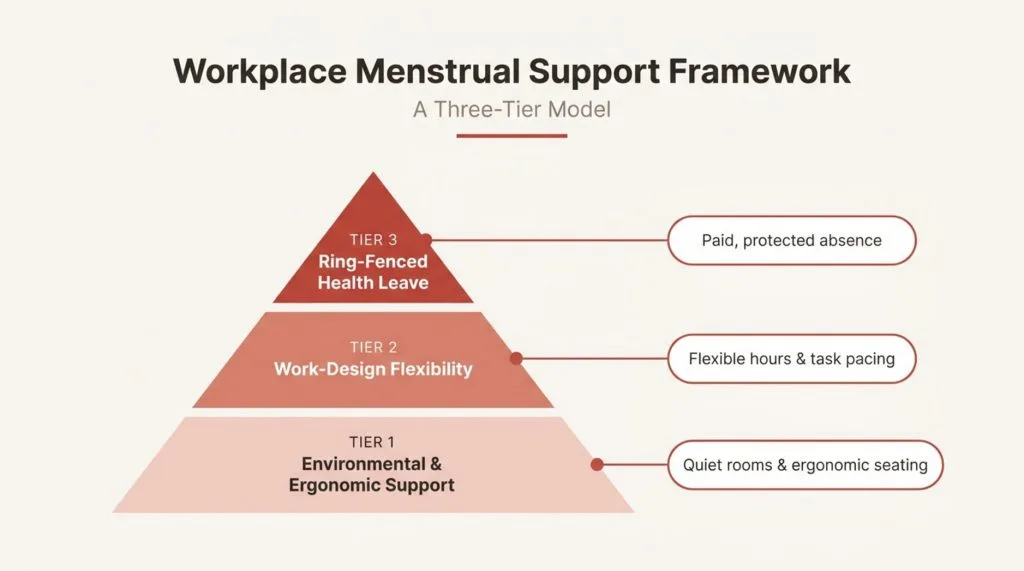
This stepped framework allows people to select the right level of support for their needs, preventing unnecessary sick days while protecting employees from having to push through intense pain.
Set Clear Eligibility, Approval and Coverage Rules
Ambiguity creates hesitation. Reproductive health policies should outline eligibility, notification steps, and workload coverage clearly. Guidelines should be inclusive of everyone who menstruates, including women, trans men, and non-binary individuals.
Notice requirements should be realistic. If someone wakes with intense cramps at 6:00 am, they shouldn’t face a complex approval chain before an 8:00 am shift. A quick notification via an HR app or direct message is often sufficient. Policies should also specify how tasks are covered, so employees don’t feel guilty about taking leave.
Train Managers To Respond Without Judgement
Policies depend on the people who put them into practice. Even the most comprehensive guidelines fall flat if managers react with awkwardness, scepticism, or intrusive questions. Businesses should provide training for team leaders on health literacy, confidentiality, and supportive communication.
Training should dismantle common misconceptions and offer managers clear communication tools. Leaders should focus on task planning and privacy, avoiding questions about personal health details. A simple response like, “Thanks for letting me know. Take care of yourself, and we’ll ensure your tasks are covered today,” builds trust across the whole organisation.
Track Uptake, Wellbeing and Retention Without Collecting Unnecessary Health Data
Organisations need to evaluate policy success, but collecting detailed personal biological data is inappropriate and creates privacy risks. Tracking individual cycle dates on workplace systems undermines trust and discourages policy use.
Instead, HR teams should monitor aggregated, anonymous trends. Useful indicators include changes in unplanned personal leave, staff turnover across demographics, feedback from anonymous engagement surveys, and career progression rates for staff using flexible arrangements. A healthy policy will typically show reduced presenteeism, stable output, and higher team morale.
Why a Combined Menstrual Health Policy Often Works Best
Match Support to Symptom Severity, Job Demands and Employee Preference
The debate between menstrual leave and flexible scheduling isn’t about choosing one over the other; it’s about matching support to real-world needs. No single approach works for everyone. A policy that blends both options recognises that physical capacity fluctuates naturally.
Staff and managers can tailor adjustments based on symptoms and daily responsibilities, keeping work sustainable. Here is a practical framework for matching support to symptom levels:
- Mild Discomfort & Brain Fog: Offer adjustable hours, reschedule focus-heavy meetings, and provide ergonomic support in the office or at home.
- Moderate Pain & Fatigue: Encourage working from home, split shifts, or planned 30 to 60-minute recovery breaks in a quiet space.
- Severe, Incapacitating Pain or Heavy Bleeding: Provide dedicated reproductive health leave so the individual can step away completely and rest without losing pay.
- Chronic, Recurrent Conditions (Endometriosis, PMDD, Adenomyosis): Put formal long-term adjustments in place under workplace health and inclusion policies, backed by confidential access to health support.
Build a Workplace Where No One Has To Choose Between Health and Career
Improving menstrual health support at work means rethinking how we design our days. For decades, traditional work cultures have operated on the assumption of steady, unchanging energy every day of the month, often treating natural bodily rhythms as a problem to hide.
Creating sustainable work environments starts with cycle awareness and practical work design. Flexible scheduling helps employees stay engaged while honouring their body’s changing energy, while dedicated leave provides a safe foundation when rest is necessary.
When organisations learn to work with natural rhythms rather than against them, they create supportive cultures where nobody has to compromise their health for their career. Deepening this understanding through menstrual cycle education helps leaders, coaches, and practitioners guide workplaces toward healthier, more cyclical ways of living and working.