

How can organisations build a cyclical wellness policy that genuinely supports employee health and sustainable productivity? A modern cyclical wellness policy aligns daily work practices, psychological safety, and flexible scheduling with natural biological rhythms and cycle phases.
By bringing menstrual cycle awareness into work design, Australian workplaces can help reduce burnout, support staff retention, and create healthier, more sustainable team cultures.
What Should a 2027 Wellness Policy Achieve?
A modern cyclical wellness policy needs to do far more than express good intentions. It should support risk management and sustainable performance through practical, everyday workplace guidelines.
Companies can’t simply rely on wellness benefits that only look good on paper. Policies need actionable safeguards that protect employee wellbeing while keeping the organisation running smoothly.
Setting clear goals and internal standards helps make menstrual cycle education and hormonal health awareness a normal, respected part of people management at every leadership level.
Set Measurable Wellbeing, Participation and Business Objectives
Clear targets form the foundation of an effective policy. Rather than relying on vague aims like “improving workplace morale”, a modern policy uses SMART goals: Specific, Measurable, Actionable, Reasonable, and Time-bound. These targets can track both Return on Investment (ROI) and Value on Investment (VOI).
Examples include reducing unplanned sick leave linked to menstrual symptoms through flexible hours, increasing participation in cycle awareness workshops, and measuring improvements in team engagement scores.
Operational targets should also track how easily staff can access reasonable adjustments and flexible work blocks. When team members have clear permission to plan their work in alignment with their cycle, work quality can improve, rework often drops, and project delivery becomes far more consistent across the year.
Link Employee Wellbeing With Safety, Retention and Performance
Workplace research clearly links supportive health environments to positive business outcomes. Gallup data indicates that organisations with flexible, appreciative cultures can achieve a significant reduction in turnover and a revenue boost of 23%.
On the other hand, expecting workers to push through severe pelvic pain, endometriosis flare-ups, or cycle-related exhaustion can harm safety and drive skilled people away.
A supportive Psychosocial Safety Climate (PSC) plays a major role in workplace results. Research shows that a 10% improvement in PSC is linked to a 4% drop in job demands, 4.5% less burnout, and 6% fewer sick days.
Supporting menstrual health needs helps build this safe environment, retaining experienced professionals who might otherwise leave when rigid structures don’t support their natural rhythms.
Work-life balance is about more than simply clocking off on time; it’s about honouring physical and mental capacity. An “always-on” communication culture, blurred digital boundaries, and unmanageable workloads are recognised psychosocial hazards that can contribute to chronic stress and hormonal disruption.
A cyclical wellness policy addresses these risks by establishing clear boundaries around cognitive load and availability. Giving staff permission to step back from high-intensity, public-facing tasks during more vulnerable phases of their cycle can help prevent burnout before it takes hold.

Align the Policy With Australian Workplace Obligations and Privacy Requirements
In Australia, employee wellbeing is tightly connected to workplace law. Under Safe Work Australia’s model Work Health and Safety (WHS) laws, employers have a legal duty to eliminate or minimise psychosocial hazards. These hazards include fatigue, poor workload management, and unsupportive workplace cultures.
Failing to support menstrual cycle health when it causes significant physical or psychological symptoms can breach WHS duties and obligations under the Sex Discrimination Act 1984.
Personal health information about menstrual cycles, reproductive conditions, and fertility care is sensitive data under the Privacy Act 1988 (Cth). The policy must clearly state that employees never have to hand over personal cycle tracking records, private medical diaries, or specific diagnoses to access flexible work arrangements or leave.
What to Include in a Cyclical Wellness Policy Template
A practical cyclical wellness policy template should be straightforward, practical, and protective. It needs to provide clear guidance for managers while spelling out transparent rights and adjustments for employees. The following sections outline the essential building blocks for a 2027 policy.
A well-structured policy bridges the gap between biological realities and workplace expectations, setting a clear, consistent standard across all teams.
1. Policy Purpose, Scope and Guiding Principles
The policy should open with a clear purpose: to build an inclusive, psychologically safe environment that supports staff through the natural rhythms of their menstrual and reproductive health. It should state that energy and physical capacity naturally shift across the cycle, and that working in alignment with these rhythms supports long-term wellbeing and team performance.
The scope must encompass all staff, whether full-time, part-time, casual, fixed-term, or remote. Guiding principles should centre on fairness, privacy, non-discrimination, and a strict rule that taking health-related adjustments will never negatively impact performance reviews or career progression.
2. Leadership Responsibilities and Employee Consultation
Every management tier requires clear, practical responsibilities. Senior leaders are responsible for resourcing support and setting manageable workload expectations. People managers are expected to approve flexible arrangements without intrusive questioning or bias. The policy should also commit leaders to regular, ongoing consultation with health and safety representatives, employee groups, and internal committees.
Continuous consultation keeps the policy relevant and practical, preventing it from becoming a purely administrative exercise designed only by senior executives.
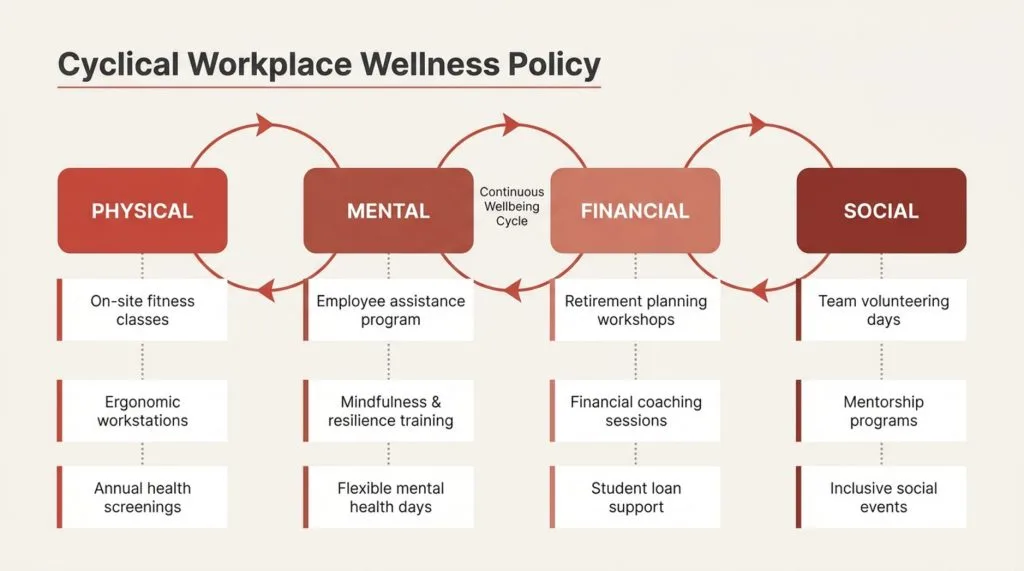
3. Wellness Initiatives Across Physical, Mental, Financial and Social Health
The policy should clearly detail tangible initiatives across four central pillars of health:
- Physical: Free organic menstrual care products in all workplace bathrooms; access to quiet rest spaces equipped with heat packs; ergonomic seating adjustments; and flexible movement options that suit different energy levels across cycle phases.
- Mental: Subsidised access to counsellors or health professionals who understand premenstrual dysphoric disorder (PMDD) and cyclical health, alongside practical education sessions on menstrual cycle awareness.
- Financial: Dedicated wellness stipends that can cover cycle-support products, gynaecological consultations, naturopathic care, or acupuncture, paired with fair wage protections during leave.
- Social: Employee Resource Groups (ERGs) focused on reproductive and cyclical wellbeing; peer support spaces; and informal learning sessions that demystify hormonal health for the broader team.
4. Flexible Work, Leave, Workload and Work-Life Balance Provisions
This section outlines the practical core of the policy. It should introduce Menstrual and Cyclical Health Leave, offering an allocated number of paid days each year (such as 10 to 12 days) separate from standard personal or sick leave. These days provide essential relief for employees managing intense pain, fatigue, or acute cycle symptoms.
The policy should also establish flexible task scheduling. Employees can request modified working hours, meeting-free focus windows, working from home, or delegating public presentations during days with acute physical or emotional symptoms, all without negative repercussions.
5. Support Pathways, Confidentiality and Reasonable Adjustments
Team members need to know exactly how and where to access support. The template should provide confidential communication channels, such as a designated People & Culture contact, an occupational health nurse, or an external Employee Assistance Programme (EAP).
It should explicitly confirm that low-barrier adjustments, such as using heat pads, taking extra rest breaks, or requesting slight deadline shifts, do not require medical certificates. All related conversations and records must remain strictly confidential within internal human resource systems.
6. Communication, Training, Incentives and Participation Safeguards
To reduce workplace stigma, the policy should mandate regular training for people managers. This education should explain basic cycle phases, illustrate how natural rhythms can influence team workflow, and teach leaders how to hold supportive, respectful check-ins without overstepping privacy.
Participation must always be safe and voluntary. Joining cycle tracking initiatives, wellness webinars, or education sessions must never be compulsory. Any workplace incentives should reward learning and engagement, never private biometric data, personal health logging, or perfect attendance records.
7. Measures, Review Dates, Owners and Approval Records
Clear administration ensures a policy stays effective. The template must identify clear operational owners, such as the Head of People & Culture or the Workplace Health and Safety Manager. It should outline fixed quarterly and annual review dates, along with formal sign-off from senior executives.
These formal records keep the policy active, useful, and accountable, rather than letting it sit forgotten in an intranet folder.
How to Review and Improve the Policy Throughout 2027
Maintaining an effective policy throughout 2027 requires ongoing attention. A company can’t simply upload a policy document to an internal site and forget about it. Regular check-ins help the policy evolve alongside team needs, modern workplace insights, and emerging health research.
Open, collaborative review cycles build trust and help organisations respond quickly to changing workplace dynamics.
Create a Quarterly Review Agenda and Decision Log
Every quarter, the wellness steering committee should run a structured review meeting. This session covers alert triggers, budget allocations, confidential survey trends, and the operational rollout of recent updates.
Every decision, whether expanding a popular initiative, adjusting a process, or retiring an ineffective tool, belongs in a central decision log. This transparent record maintains continuity and clarity, even when internal roles or HR teams change over time.
Use Employee Feedback To Retire, Adapt or Expand Initiatives
Companies should feel comfortable stepping away from initiatives that aren’t delivering real support. If an informational webinar sees consistently low attendance or a recommended tracking tool doesn’t resonate with staff, it makes sense to adjust or phase it out.
Reallocating resources into high-value initiatives, such as expanded flexible working options or better rest facilities, demonstrates that leaders are listening and responsive to actual employee feedback.
Test Small Changes Before Scaling Them Across the Organisation
Before launching major adjustments company-wide, employers can pilot ideas within a single team or volunteer cohort. For instance, meeting-free focus days or asynchronous handover systems can be trialled within design or operational teams before being rolled out more broadly.
These smaller trials provide practical insights, real-world examples, and internal champions. They make wider implementation smoother and avoid unnecessary disruptions to everyday operations.
Publish Progress Updates While Protecting Individual Privacy
Clear, open communication helps employees feel invested in the process. Twice a year, leadership can share a brief, de-identified summary covering key policy milestones, overall participation, and planned improvements.
Sharing these milestones reassures staff that their input is valued and that leadership remains committed to healthy working practices. Transparent reporting builds confidence while keeping individual health experiences completely confidential.
Prepare the Next Annual Cycle Using Lessons From 2027
As 2027 winds down, leaders should review the year’s decision logs, survey feedback, and operational metrics. This comprehensive review forms the practical foundation for designing the 2028 wellness calendar.
When an organisation approaches policy design as an evolving, cyclical process, it creates a lasting culture rooted in dignity, sustainable lifestyle practices, and genuine support for natural human rhythms.
Future-Proofing Biological and Cyclical Health for 2028 and Beyond
Looking ahead, workplace design will continue to weave together natural biological rhythms, supportive management, and progressive workplace standards. Forward-thinking organisations are already recognising that menstrual health, fertility awareness, and hormonal transitions are normal aspects of working life that benefit from thoughtful, structured workplace support rather than silence.
With an increasing focus on managing psychosocial risks sustainably, Australian workplaces that embrace menstrual cycle awareness and flexible, cyclical living are setting a higher standard. Deepening your understanding of the cycle and learning how to support cyclical health can help transform workplace cultures, nurturing environments where both individuals and teams can thrive sustainably.